




Rumour and Riot: Deconstructing the Communal Violence in Benibad, 1946
1.0 Introduction
In the tumultuous autumn of 1946, as the political landscape of British India fractured along communal lines, the province of Bihar became a landscape of profound suspicion and violence. This paper dissects the riots that engulfed the village of Benibad in the Muzaffarpur district in September of that year, presenting the event as a tragic case study in the mechanics of communal conflict. It argues that the violence in Benibad was not an atavistic outburst, but a meticulously engineered event, representing the direct consequence of a weaponized rumour acting upon a communally charged atmosphere, deliberately stoked by organized groups and inflammatory political rhetoric.
This examination will deconstruct the core elements that culminated in the tragedy. It will trace the genesis and dissemination of the central rumour—the alleged abduction of a Bengali Hindu girl by a local Muslim man—and contrast it with official records that tell a story of voluntary conversion and marriage. Furthermore, the paper will analyze the role of organized groups, such as the Arya Samaj, in mobilizing actors for violence, the timeline of the riot's eruption, and the catastrophic failure of state machinery to intervene in time. Finally, it will document the devastating aftermath for Benibad's Muslim community, quantifying the human and material cost of the violence.
By moving from the general political climate to the specific anatomy of the Benibad rumour and its violent consequences, this paper seeks to illuminate how misinformation can serve as a potent and deadly catalyst in moments of acute social and political tension.
2.0 The Tinderbox: Pre-existing Communal Tensions and the Politics of Retaliation
To fully comprehend the events in Benibad, it is crucial to understand the broader socio-political climate of 1946. The violence did not occur in a vacuum; it was conditioned by a pervasive atmosphere of suspicion and a potent political narrative of retribution that had taken hold across the region. The incident was a localized spark falling upon a landscape already saturated with communal fuel.
Antecedent events, particularly the Great Calcutta Killing of August 1946, played a pivotal role in shaping public sentiment in Bihar. The violence in Calcutta was followed by "widespread rumours that hundred of Hindus girls had been kidnapped." These accounts, whether factual or exaggerated, cultivated an "idea of retaliation" within Hindu communities, creating a psychological readiness to believe the worst of their Muslim neighbours and to view violence as a justifiable response. The narrative of abduction became a powerful trope, primed to ignite conflict wherever it was deployed.
This volatile atmosphere was further inflamed by the rhetoric of political leaders. B. S. Moonje of the All India Hindu Mahasabha and Ganganand Sinha of the Bihar Hindu Mahasabha made "extremely offensive statements" that openly celebrated retaliatory violence. Their assertion that "'the Muslims had been fully paid back in their coins yet without any cowardlinesses'" did more than just condone violence; it framed it as a necessary and even heroic act of communal self-defense, effectively sanctioning aggression. It was into this pre-existing tinderbox of fear, rumour, and political incitement that the specific story of a Bengali girl in Benibad was introduced.
3.0 The Spark: Anatomy of the Benibad Rumour
The immediate trigger for the Benibad riot was a rumour that combined the volatile themes of abduction, forced conversion, and communal honour. This section deconstructs the central rumour by dissecting its competing narratives, contrasting the unsubstantiated claims that fueled the violence with the documented evidence that presented a starkly different reality. The gap between these two accounts reveals the process by which a personal story was twisted into a public pretext for mass violence.
3.1 The Narrative of Abduction
The rumour that circulated with deadly effect among the Hindu community had a clear and provocative core: a Muslim boy from Benibad named Ali Hasan had “‘abducted’ a Hindu girl named Kalyani Dey from Bengal, and converted her to Islam.” This narrative was first brought to local attention when two Bengalis and an Arya Samaj leader, Kuber Singh, approached a village elder. One of the Bengalis gave the complaint a personal dimension, claiming that the girl was his cousin (Bahin) and had been kidnapped during the Calcutta riots.
This core story was quickly embellished with more lurid details designed to provoke outrage. "One Lochi Mishra," identified as a local zamindar, circulated a particularly inflammatory version. He falsely claimed that Ali Hasan had not only abducted the girl (renamed Noor Jehan Begum) but also possessed Rs. 5 Lakhs in looted property from Calcutta. This addition of a new Muslim name and the mention of vast sums of "looted property" transformed the alleged personal crime into an act of organized communal aggression, linking it directly to the recent violence in Calcutta.
3.2 The Narrative of Voluntary Conversion
Official inquiries and direct testimony from the young woman at the center of the controversy paint a picture that directly contradicts the narrative of abduction. Official documents establish that Kalyani Dey, aged about 20, voluntarily appeared before the imam of the Nakhoda Mosque in Calcutta on July 26th, 1946.
Her intentions were recorded in a solemn declaration, which stands as the most definitive piece of evidence in the case. She stated:
"I Kalyani Dey... do hereby declare on solemn oath that I am neither induced or influenced nor persuaded or compelled to renounce my present faith, but the teachings of Islam having impressed upon my mind, [makes me convert to Islam]".
This sworn testimony refutes the central claim of coercion. Reinforcing this, it was subsequently "ascertained that the girl had, in fact, embraced Islam, and was regularly married to the Muslim, with whom she was living." The official record thus transforms a story of violent abduction into one of voluntary religious conversion and marriage, an act of personal agency that was deliberately erased by the riot-mongers.
3.3 Official Intervention and Escalation
As the rumour gained traction, it triggered a series of official actions that, instead of defusing the situation, inadvertently set a deadline for conflict. On September 17th, a petition was filed before the Additional District Magistrate concerning the case. This led to a police inquiry conducted by Inspector J.B. Jha on September 20th.
During this inquiry, a fateful agreement was reached: local Muslims agreed to produce the girl before the authorities within seven days to clarify the matter. This set the date for her appearance as Friday, September 27th. While likely intended as a measure to resolve the dispute peacefully, this seven-day waiting period allowed tensions to fester and provided organizers of the violence with a specific date and time to rally their forces. The stage was set for the rumour to be adjudicated not by testimony, but by mob violence.
4.0 The Eruption of Violence: From Rumour to Riot
The carefully constructed rumour, amplified by a volatile political climate, culminated in a planned attack on Benibad, abetted by a protracted failure of state intervention. The violence unfolded in two distinct waves, with a critical three-day period in between during which authorities recognized the danger but failed to act decisively.
The first "communal outbreak" occurred on September 24th, 1946, when 11 Muslims were killed and their houses were burnt and looted. This initial attack served as a clear and violent warning of what was to come. Indeed, when the Sub-Divisional Officer (SDO) returned from a nearby police station on that same day, he "realized that the situation was quite serious." Aware that the Muslims had agreed to produce the girl on September 27th, the SDO decided to take armed police to Benibad on the morning of the 25th.
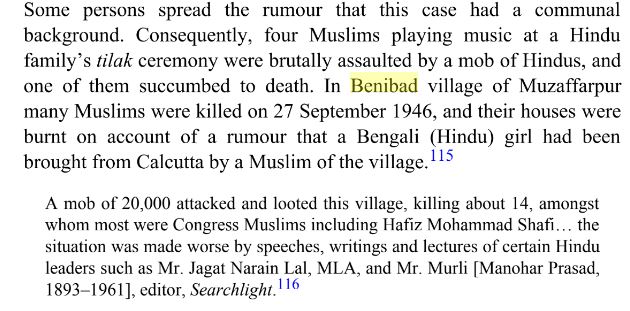
Despite this recognition of imminent danger, two days passed without effective intervention. On September 27th, the day the girl was to be produced, the situation escalated into a full-scale riot. An initial group of "700 Arya Samajists attacked the Muslim of Benibad," followed by a much larger "mob of 20,000" that attacked and looted the village, killing approximately 14 people. Significantly, the victims were identified as being "most[ly] Congress Muslims including Hafiz Mohammad Shafi," suggesting the violence was not only communal but also targeted specific political affiliations. The situation was further "made worse" by the inflammatory speeches of Hindu leaders like Mr. Jagat Narain Lal and Mr. Murli Manohar Prasad.
The tragedy was cemented by a final logistical failure. An armed police force with a magistrate was eventually dispatched, but the mission was doomed by the "accidental breakdown of a police truck." As a result, the force did not arrive "until after the incident had occurred." This breakdown was not merely an unfortunate accident; it was the final point of failure in a response that had been delayed for at least two days after the authorities were fully aware of the grave threat to the village.
5.0 The Aftermath: Quantifying the Human and Social Cost
The impact of the Benibad riots extended far beyond the immediate violence of September 27th. The attacks left a legacy of death, destruction, and displacement, from which the local Muslim community struggled to recover amid official neglect and continued harassment. This section quantifies the human and material losses and analyzes the prolonged suffering that followed the riot.
The official statistics from the violence paint a grim picture of the human cost. The casualties and property damage included:
- Fatalities: The total casualty count was reported as 14 killed, with 13 dead bodies found and one body missing.
- Injuries: 6 people were officially recorded as wounded.
- Property Destruction: Official reports stated that "200 houses belonging to 80 families of Mohammedans had been burnt."
For the survivors, the ordeal was far from over. The relief efforts organized by the government were described as "poor and slow." A "promised amount of relief of Rs 40,000 remained undelivered," leaving the 80 displaced families without the resources to rebuild their lives and homes. The insecurity was compounded by ongoing lawlessness, with cases of looting continuing until at least February 1947. Furthermore, the Muslim community was subjected to "tortuous and harassing" house-searches by authorities, a practice that only deepened their sense of persecution. The cumulative effect of this trauma was a profound loss of faith in their security. Dr. Syed Mahmud, observing the relief efforts, noted he "had received applications from 400 Muslims wishing to go to Sind," a stark figure quantifying the community's despair and accelerating the process of migration from the region.
6.0 Conclusion
The communal riot in Benibad in September 1946 stands as a stark and tragic illustration of the power of misinformation in a polarized society. The violence was not an accident of history but the calculated result of a deliberately circulated rumour of abduction. This narrative, as shown by official records and the direct testimony of Kalyani Dey, was demonstrably false. Her voluntary conversion to Islam and marriage were intentionally reframed as a story of communal aggression to serve a violent political agenda.
This weaponized rumour found fertile ground in the pre-existing political climate of Bihar, which was saturated with narratives of retaliation following the Calcutta riots. Inflammatory rhetoric from political leaders, coupled with the organizational capacity of groups like the Arya Samaj, transformed suspicion into a mobilized mob. The catastrophic failure of the state—first to act decisively after the initial violence on September 24th, and then to deploy its security forces successfully on the 27th—sealed the fate of Benibad's Muslim community.
The Benibad tragedy thus endures as a vital case study, demonstrating that in the charged atmosphere of Partition-era India, the anatomy of a rumour was, in fact, the blueprint for a riot.
Reference5. Pyarelal. (1956). Mahatma Gandhi: The Last Phase : Volume 1, Book-one, Volume 1, Book 1. Navajivan Publishing House,.


Very Interesting! Please give the reference of the source book.
ReplyDeleteAs the report says,The then administration, Government and the committee had enquired, investigated and concluded unbiased and uninfluenced.
ReplyDelete